Team
Team
BOŠTJAN LIPOVŠEK, animal keeper
.jpg&w=3840&q=75)
As a veterinary technician, I first seriously encountered the zoo as a secondary veterinary school trainee, when we had weekly practical classes at Ljubljana Zoo. I enjoy unusual sports, and the zoo too has offered me its own kinds of challenge. After finishing my studies at the Biotechnical Faculty, I was employed at Ljubljana Zoo. I got to know the work with all the animals. Today I spend most of my time training the sea lions and the red pandas. I am one of four keepers at the zoo who work with them and train them. I am aware that it is important for the animals that we enrich their days with additional activities. For the sea lions, I have made many different devices that keep them busy and bring variety to their day.
IRENA FURLAN, biologist and head of education
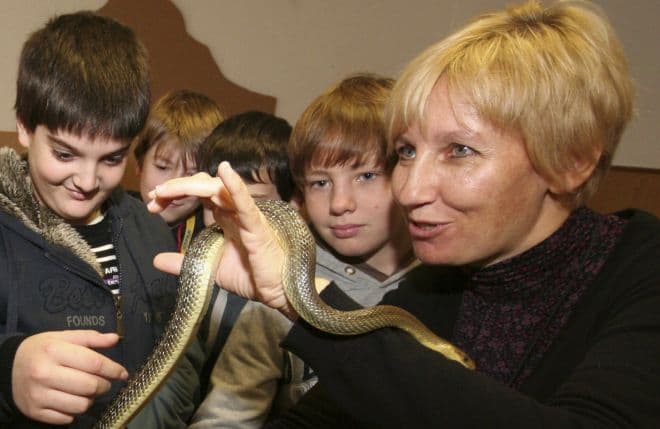
One animal very dear to me, especially from fairy tales in my childhood, is the common toad. Unconsciously I still wonder whether, if I kiss it, it will turn into a prince or a princess? I am always fascinated when I look into its beautiful orange eyes with the large, black, horizontal pupil. Its skin also surprises me — soft and pleasant to touch. Our visitors have many unfounded prejudices about this very toad. I understand this well, as I overcame my own phobia of spiders and can empathise with their feelings, which helps me help visitors overcome various prejudices about animals. In this work I meet very interesting people. I am grateful to them for unusual and pleasant experiences that enrich me. I love spending my free time in nature with my family, where I constantly look for inspiration for my work at the zoo, which I have been part of for more than a quarter of a century. I wish our animals many kind and considerate visitors.
JANA ŠTIFTAR, animal keeper
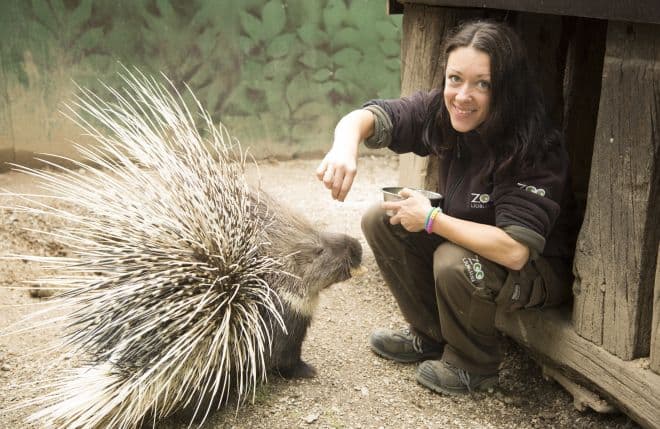
Hello, beside me is an Indian crested porcupine, which belongs to the rodents. Bibi, as I affectionately call her, is extremely intelligent and easy to train. She is also very sociable, so I sometimes surprise her with a peanut, even though she also likes all kinds of vegetables and fruit. She has quills, yet her closest relative is not the hedgehog but — you won't believe it — the mouse. When Bibi gets angry, she rattles her quills, which are hollow, and she can even charge backwards at an attacker. If she accidentally pricked another member of her family with a quill, that animal's body would immediately begin producing a kind of antibiotic that prevents infection. Porcupines are classified as endangered because of the good taste of their meat.
JOŽE KRAŠEVEC, animal keeper
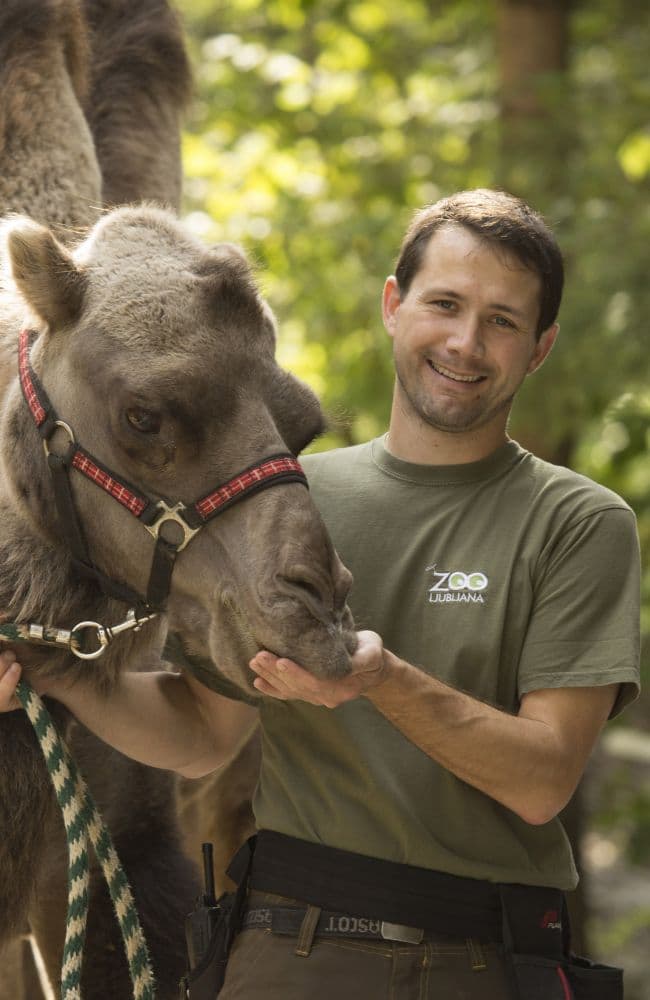
I have worked at the zoo for a very long time. I have cared for almost all the animals here, but my favourites are the big cats. At our zoo we have three representatives of the big cats — cheetahs, Persian leopards and Siberian tigers. The tigers are especially close to my heart. Although Amur and Danuta eagerly wait for me in the morning to let them into the outdoor enclosure, it is not without first preparing their "daytime" space. First their outdoor enclosure has to be cleaned, the fence around it checked, a toy put out for some fun, and perhaps the whole space "scented" with spices. They especially adore cinnamon. When I let them into the outdoor enclosure, they always first check whether any surprise is hiding somewhere. If Amur finds cinnamon, he first smells and licks it, and then rolls around in it as a bonus. Throughout the day I check on them several times — their behaviour, their wellbeing — especially if they are together. In the evening it is a similar story: they can hardly wait for me to open the hatches into their indoor space, as a delicious dinner awaits them. Sometimes, of course, they surprise me in the evening too — especially on rainy days, when they love to leap onto the fence and treat me to a mud bath. All that is left is for me, covered in mud, to jump into the shower as well.
LARA KUNST, animal keeper
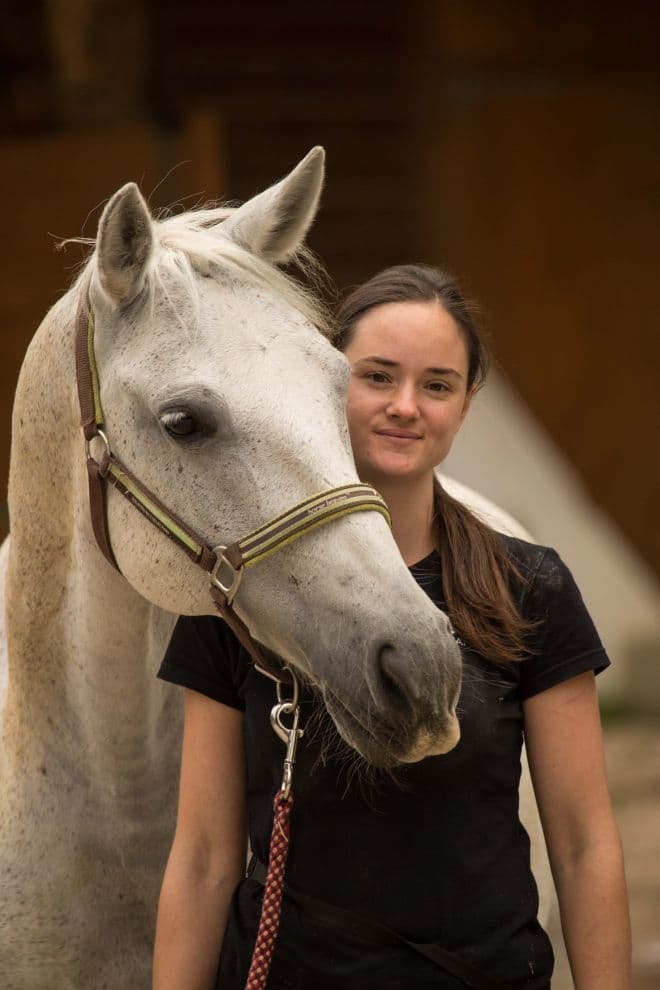
My story at Ljubljana Zoo began only recently. Although my studies led me in an entirely different direction — by training I am a geological engineer — my desire to work with animals, which I had nurtured since childhood, won out. I am currently gathering experience in handling and training animals and in finding ways to enrich their everyday lives. Closest to my heart are the animals at our Slovenian farm, where we showcase indigenous Slovenian breeds. Through them we run an educational farm programme, in which we take each breed out of the enclosure in turn and present them to visitors. Thanks to daily training, animals follow us out of the enclosure and back in again. We have also taught some of them a trick or two. One such example is our Drežnica goat, named Soča, who can perform a few basic exercises such as following a target, standing still, turning around, going backwards and even giving a "paw". Life with animals is interesting, joyful and full of surprises every day.
MATIJA HREŠČAK, animal keeper
I was already interested in keeping and caring for animals in secondary school, where I kept animals in the school vivarium. After finishing secondary school, Lady joined me — a border collie, a breed known for being exceptionally clever. She taught me how animals learn. I devoted all my free time to her and taught her many tricks, with which we later performed in commercials. I started working at the zoo as a student assistant to the animal keepers, and later I had the chance to start training animals on the Slovenian farm as an employee. With my colleagues I presented important representatives of Slovenian breeds to our visitors. After a year of reassignment to the Ljubljana Animal Shelter, I returned to the zoo as a keeper, and today I care for the chimpanzees and the animals that live in the steep part of the zoo. I would like visitors to help us a great deal by buying toys for the zoo animals to brighten their day.
MATIJA RAMŠAK, animal keeper
I came to the zoo in the early 1980s, still a teenager, as a member of the Ljubljana Aquarists' Society. In the building where the vivarium now stands, three of us looked after the aquariums. Once we had cared for the fish, the keepers were very grateful for any help. I most often helped keeper Bojan, who cared for the herbivores. And that is when I saw her. With her size, her calm appearance and the warmth in her eyes, she captivated me at once. It was love at first sight. From then on I came to the zoo almost every day, tended to the aquariums, and then went to her. I was immeasurably happy that — under the supervision of keeper Bojan, of course — I could clean her enclosure, wash it and feed her. She is now forty-one years old, and we are very good friends. I know that Ganga loves us too, because she always helps us with her daily care. Before that, there was a lot to learn. Every year we take part in various workshops, seminars and other training courses, and two events left a particular mark on me: the elephant training in Hamburg and the second giraffe conference in San Francisco. When I am at home, I think a lot about how to enrich our animals' life at the zoo; I made a sprint device for the cheetahs, and I am now working on a surprise box for the tigers.
MOJCA HAREJ, animal keeper
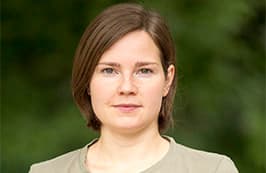
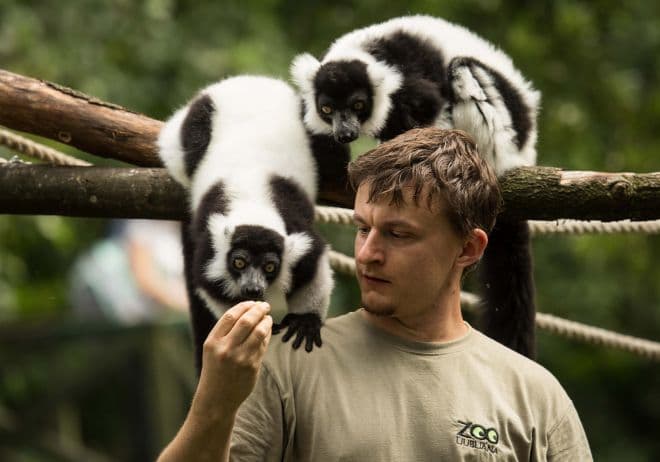
My name is Mojca Harej and I am an animal keeper at Ljubljana Zoo. I remember that as a child I already showed a great interest in animals and working with them. Although I did not later choose to study in this field, life brought me to this path. My story at the zoo began only recently: I first worked for a year as a veterinary assistant. As someone without experience in the field, this work was a great challenge, but my desire to work with animals and to learn and discover new things helped me greatly. In this work I gained a great deal of knowledge and experience and came to know the nature and behaviour of many animals. I am now a keeper and care for a particular group of animals. These include two species of primate — black-and-white ruffed lemurs and chimpanzees. I love both, and the ruffed lemurs are especially close to my heart, as they are very gentle, lovable and friendly animals. Working with chimpanzees is of course quite different: caution is always needed, as they can be very mischievous, even dangerous. But they are very intelligent and quick to learn, so working with them is a great pleasure — it is there that I have gained much experience in animal training. As keepers we also take care to enrich their environment with various new objects, toys, scents, puzzles and the like, so that the chimpanzees, and other animals too, do not become bored.
PAVEL KVAPIL, head of veterinary services
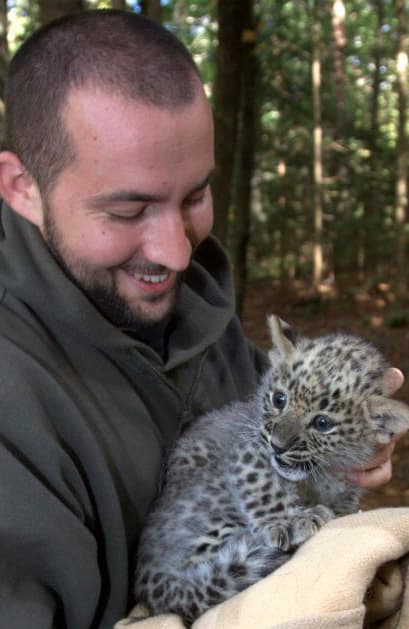
The work of a zoo veterinarian is no longer simply a combination of field work and clinic work in which animals are treated, but an independent specialisation with an emphasis on preventing disease in exotic and wild animals. This demands lifelong study of a very wide range of animal species and their environments. A zoo veterinarian is usually a very unpopular person as far as the animals are concerned, as we tend to bring them unpleasant experiences. That is why I am happiest when I can focus on the animals outside the everyday routine and observe them enjoying pleasant situations. I knew I wanted to help animals when I was three years old. My enthusiasm for the special world of zoos and wildlife was further fuelled by the books of Gerald Durrell and David Taylor, which I read in primary school. Being a vet for me is not just a job — it is a calling and a way of life.
ROBERT PRAŠNIKAR, animal keeper
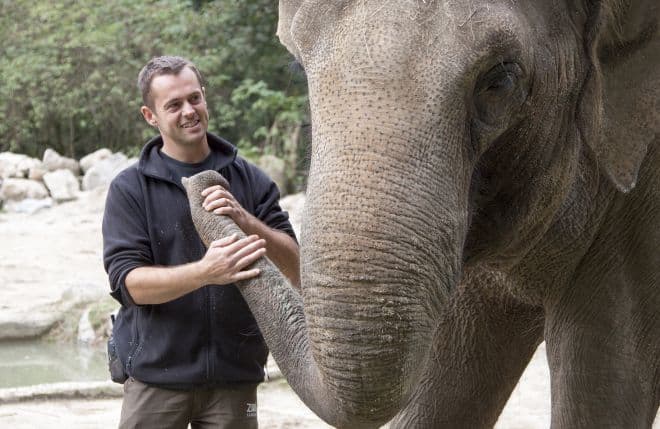
I have been an animal keeper for 15 years. All this time, the elephant Ganga has been in my care, and over these years we have developed a special bond. I first met her while on placement with the secondary veterinary school. Ganga impressed me with her size and her intelligence, which at times exceeds the boundaries of the animal world. It was precisely this that challenged me to establish a close bond with her, as an elephant — being a social animal — needs one. Unfortunately, Ganga, now in her 42nd year, has only us keepers for company, and every one of us devotes special attention to her. We therefore train Ganga daily for veterinary needs, for her wellbeing and, of course, for demonstrations to visitors. Although Ganga is a very strong animal, weighing a solid 3,300 kg, over the last decade we have trained her exclusively using the "clicker" method. We gained the knowledge for this kind of work abroad, where we regularly go for training to refresh our skills. Making toys for Ganga is another particular challenge for me, as she needs them to maintain her physical and mental health. Unfortunately, these toys often have a very short lifespan, as Ganga destroys them on first use and, in doing so, makes sure that we keepers are never bored either. I wish Ljubljana Zoo continued success in this direction, and many more successful projects for the conservation of endangered animal species.
ROBERT FLERE, animal keeper
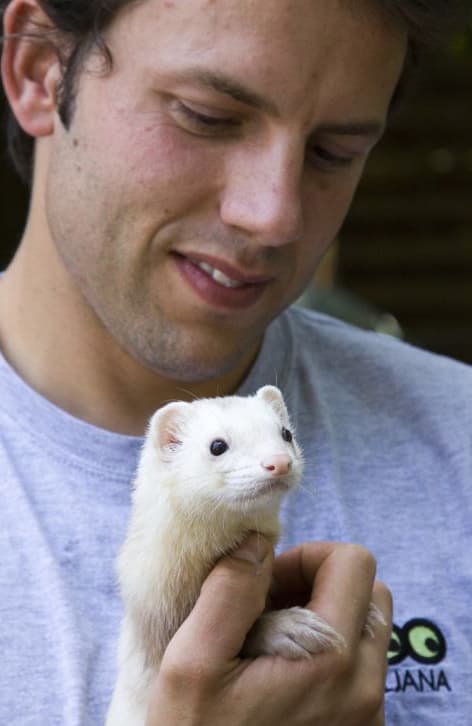
The sea lions Kalle and Jip are my favourite animals, and I have been caring for them at work for the last few years. Their feeding is linked to training, which we carry out several times a day and also demonstrate to visitors. Training sea lions is an interesting but demanding task. It requires considerable knowledge and patience on the trainer's part when building on particular exercises. This way we give the sea lions more exercise, daily mental stimulation, and above all easier handling for their daily care and for any veterinary visits. They cooperate well in training, and are rewarded for their actions with fish. Each correctly performed exercise is also marked by a short whistle on a high-frequency whistle. I am happy when I drive past the pool and they recognise me from afar. It gives me extra motivation for continuing work. Working by the pool is fun — sometimes I even fall in. I first encountered zoo work in 1999, as part of the compulsory placement at the Biotechnical Faculty. At that time the pool was "ruled" by a Patagonian sea lion called Miško. By training I am a graduate animal scientist with a major in animal nutrition. I have always been interested in the nutrition of animals and people, so I follow developments in this area, and I also love cooking and baking.
SAŠA PURKART, head of the animal kitchen
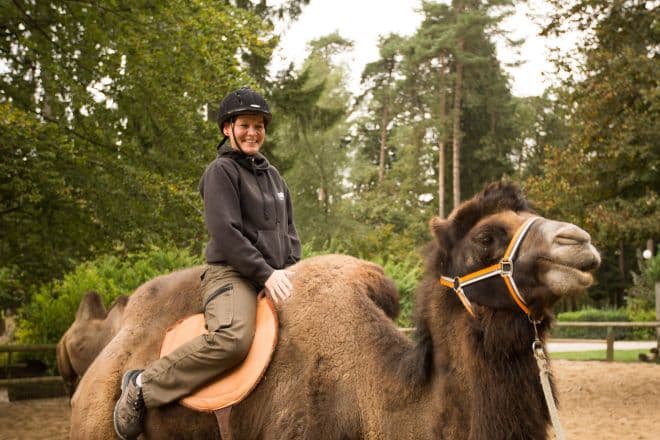
At the zoo I am employed as the head of the kitchen, which means that I order and prepare food for the animals. I love this work, because in this way I ensure that every animal receives suitable, high-quality food. I do not have daily direct contact with the animals, but when time allows I gladly go and visit and cuddle them. I love all the animals, though frogs are not quite my favourite. By training I am a graduate agronomy engineer. I love attending training courses on animal nutrition, because I see in the health of the animals how important proper feeding is. I therefore wish visitors would not feed the animals with human food. I spend my free time with my two children, most often outdoors in nature, and we also often visit the zoo.
ŠPELA ŠTRUS, veterinary assistant
By nature an eternal scout, a nature lover and a lover of furry ears. I joined the zoo in 2008 as a student in the keeping and maintenance service. It was Ljubljana Zoo that made me fall in love with all the non-furry ears too. The green iguana particularly captivated me. Who would have thought that a creature that looks like a dinosaur could look into your eyes and absolutely love being cuddled? They are wonderful.
Today, as a veterinary assistant, I work with a team of vets to care for the health of the animals that have found a home beneath Rožnik. Above all, we focus on preventing disease and help with training for voluntary clinical examinations and blood sampling. Alongside physical health, together with the keepers we also look after the mental health of the animals, enriching their environment and stimulating their physical and mental abilities. You too, dear visitors, can be part of our animals'' wellbeing by treating them with respect and following zoo etiquette.