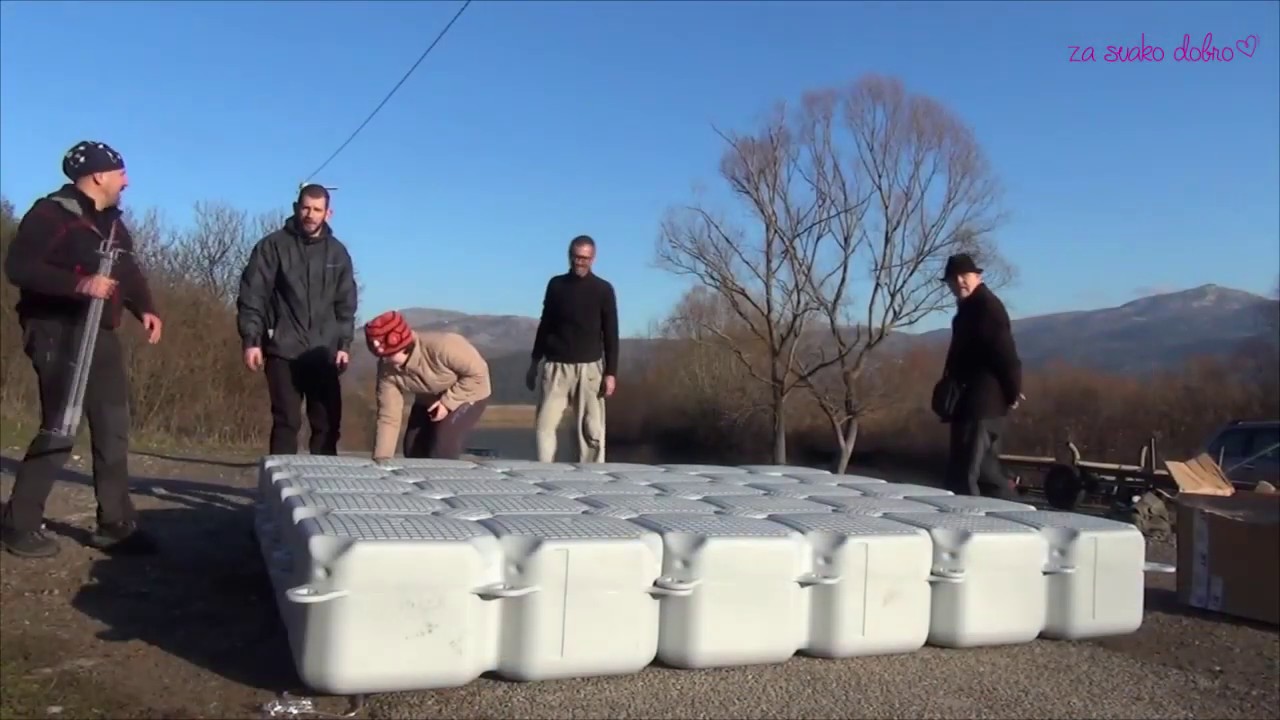
The aim of the "Pelican Village: Life on a Raft!" project is to install an additional raft for nesting endangered Dalmatian pelicans on Lake Skadar.
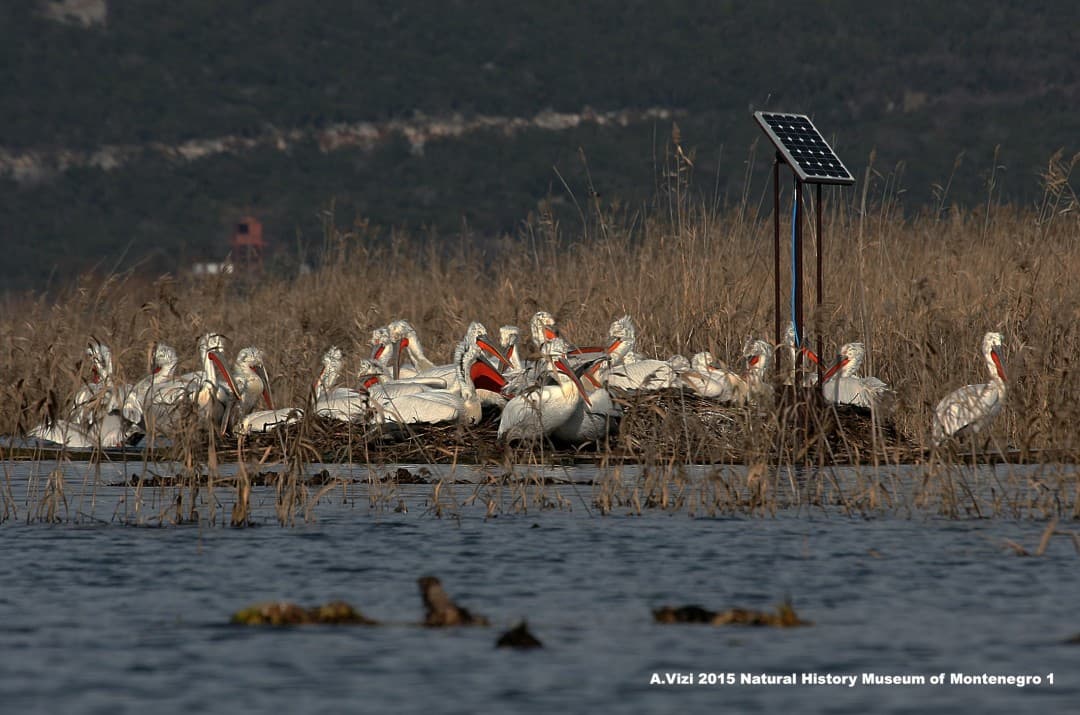
The aim of the "Pelican Village: Life on a Raft!" project is to install an additional raft for nesting Dalmatian pelicans (Pelecanus crispus) on Lake Skadar, helping to conserve this globally threatened bird species. Because natural islands of aquatic vegetation no longer exist on Lake Skadar, the pelican population is entirely dependent on artificial nesting sites and their protection.
Chronological overview of activities to conserve pelicans on Lake Skadar
2013 — under the project "Conservation of the pelican, a keystone species of Lake Skadar biodiversity", financed by the Critical Ecosystem Partnership Fund (CEPF) and coordinated by Noé, together with partners Tour du Valat, EURONATUR, the Public Enterprise for National Parks of Montenegro (NP), the Centre for Protection and Research of Birds (CZIP), the Natural History Museum (NHM), the Society for the Protection of Prespa and the Albanian Institute for Nature Protection, four interconnected nesting rafts were launched near Panceva Oka on Lake Skadar in Montenegro. Installation was carried out by Noé, NP, CZIP and NHM, working together. The nesting area was 36 m², and in record time, in March 2014, the first pelican nests were observed.
2014 — Pelican nesting in Montenegro begins early, usually in December.
In March the colony is full of eggs and the first chicks. The first nests to be spotted on the rafts were built after the pelicans had used their natural nesting sites — floating islands. The first nest was soon followed by others, and the rafts filled up by the end of the breeding season. Only the edges of the rafts, where the birds gathered and rested, were kept clear. According to a report by Andrej Vizi (NHM) in 2014, the estimated number of breeding pairs was 49, and the number of chicks was 27. The pelicans were also monitored through a video-surveillance system, which provided images every few seconds.
2015 — In 2015 the pelicans completely abandoned nesting on the natural islands and nested only on the rafts.
This protected the nests and eggs from seasonal flooding and concentrated the colony in one location, making protection easier. NP and NP Lake Skadar worked to protect the colony, supported by the project. The number of human disturbances decreased, contributing to a very good breeding season, and the number of chicks almost doubled.
In December 2015 the rafts were repaired.
Some of the nesting material was partially removed and the rafts reinforced. Repairs were needed because, under the weight of the nests and the pelicans, the rafts had been almost entirely pushed below the water surface — but not submerged.
2016 — Thanks to the CEPF-financed project and additional funding from the MAVA Foundation, Noé, together with its partners, planned the installation of a new nesting raft.
This raft was built on pontoons, again with an area of 36 m², covered with wood and fitted with "pelican ladders". The new raft is estimated to remain stable for more than 30 years and provides a more durable nesting space. However, pelicans favour the oldest rafts, installed in 2013, where they always build their first nest. NP and NHM donated and installed three smaller rafts, which were attached to the oldest rafts. One of the smaller rafts became a permanent mount for the video-surveillance system, which was upgraded to show real-time video and included a night-vision camera.
In the same year, an information centre and rangers' station was completed at Podhum, along with a campsite, a boat channel and an informational trail, financed by CEPF, MAVA and GIZ. This was the start of an ecotourism programme based on sustainable pelican watching. The programme continues to develop in 2020.
2017 — The 2017 breeding season proceeded as usual.
The pelicans accepted the raft installed the previous year, and the colony expanded its nesting across all the rafts. In December 2017 the oldest rafts were again renovated. The whole structure was reinforced with wood, so that four rafts were permanently joined together, with three smaller rafts added in 2016.
2018 — A new raft, partly funded by Ljubljana Zoo
The French NGO Noé, Ljubljana Zoo, the NGO "Centre for Protection and Research of Birds of Montenegro" and the travel agency "Undiscovered Montenegro", through the project "Wetland management and conservation of the Dalmatian pelican in the Mediterranean basin", purchased a new raft for the pelicans. The project was established by MAVA, and "Pelican Village – Life on the Raft!" was financed by Telekom of Montenegro as part of the "Za svako dobro" programme. This latest nesting raft is made of 72 modules, again with 36 m² of surface area. It is highly resistant to wind, waves and damage, and is estimated to last more than 30 years. The raft was placed close to the old nesting rafts and was initially used only as a gathering place for the birds, while the old rafts were used for nesting. Gathering in flocks on the rafts is very important for pelicans, as they do this for 70% of the day. This raft became an important gathering spot for young birds that had left the nest but can still stay close to the colony. The birds accepted the raft quickly, though after only a few days it shows signs of weathering. An early installation of newer rafts would give the pelicans time to fully accept them and eventually leave behind their beloved old nesting area. The same donor group also financed a new video-surveillance system with more features and a clearer image. The new video surveillance was also more stable, powered by a stronger solar system in 2018. The monitoring data gathered by Andrej Vizi and Nela Vesović Dubak recorded 61 chicks that had left the nest.
2019 — This year was one of the most successful for the pelicans on Lake Skadar.
Seventy-three chicks fledged, a new record. The newest raft was not used for nesting, but it was certainly used for gathering pelicans into flocks. The new type of raft was also observed by other species, mainly for resting or hunting — such as gulls, ducks and herons.
2020 — The breeding season started as usual: nests were first built on the oldest rafts (those from 2013), then progressed to the second raft (2016).
Finally, in February, nests were observed on the newest raft. In time, it became clear that the pelicans had fully accepted the newest raft and that the first eggs had been laid there. By the end of February 2020, the colony site was full of eggs, with 2 to 4 eggs per nest, which is the usual number for this species. Unfortunately, due to a number of issues that kept national park rangers away from the nesting site, disturbance of nesting by illegal fishermen took its toll on the eggs. The birds did not sit on their nests through the nights, as the fishermen frightened them off at dusk. Quarantine measures due to the new coronavirus caused additional problems, as poachers took even greater advantage of the situation and caused further disturbance. The disturbance in March was soon followed by another peak of night and day disturbance, which resulted in the destruction of almost all the eggs in the colony. The current state of the breeding success is yet to be seen, but the outlook is not good. We can see that the breeding failure was not caused by any natural factors; the poor breeding results will be the result of direct disturbance by poachers.
Final figures:
- Pelicans have more than 120 m² of nesting space
- The number of chicks was 27 in 2014 and 73 in 2019!
- In addition to the nesting rafts, a video-surveillance system has been installed to monitor the colony 24/7
- A zoned area of 300–800 m around the colony has been established
- Six information boards have been installed to educate visitors about the presence and sensitivity of the pelican colony
- A variety of educational activities have been carried out, including annual education for schoolchildren
The ultimate goal is to establish tourism based on sustainable pelican watching, so that local communities are motivated to protect the pelicans — as they become a source of income — and at the same time less tolerant of, and involved in, illegal activities that damage eggs and chicks.