Ljubljana Zoo financially supports the Red Panda Network, an organisation working in Nepal on the border with India that is dedicated to preserving the habitat of red pandas.
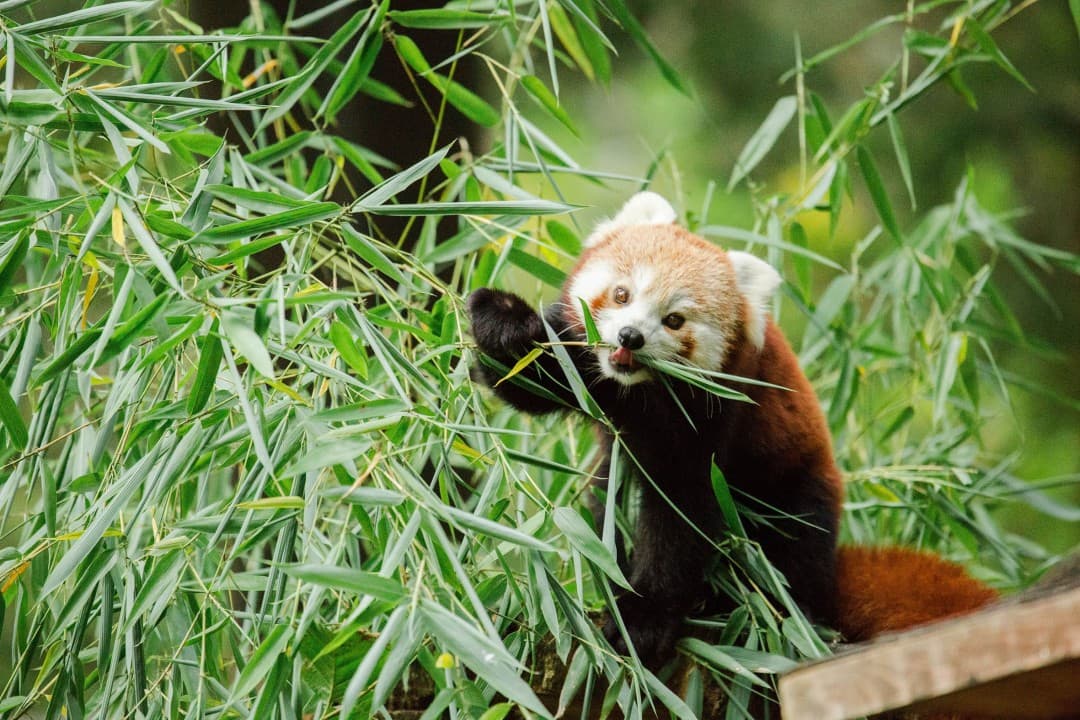
Red pandas are, unfortunately, severely endangered, so the zoos working within the umbrella EAZA organisation are collaborating on red panda conservation projects in the wild. Ljubljana Zoo financially supports the projects of the Red Panda Network. You can help them too with a donation!
Red pandas are listed as endangered on the IUCN Red List. They are successfully bred in zoos, where around 60 cubs are born each year. At Ljubljana Zoo we have been raising awareness about the challenges facing these small herbivorous carnivores for many years. Our visitors can meet our animal ambassadors Magu and Muka, who are part of the European Endangered Species Breeding Programme. As ambassadors of their species, they also play an important role in educational programmes for our visitors.
As members of the European Association of Zoos and Aquaria (EAZA), we participate in red panda conservation projects in the wild. Ljubljana Zoo financially supports the Red Panda Network, which operates in Nepal on the border with India and works to preserve the habitat of red pandas. In this area — a biodiversity hotspot in the eastern Himalayas — red pandas are an indicator species, since their numbers are linked to the distribution of forest and the amount of bamboo within it. The red panda is the only representative of its taxonomic family, which also makes it very important.
Every donation you make for red pandas is added to a fund supporting projects in their natural habitat.
The Red Panda Network works closely with local communities, involving them in stewardship of the environment while improving their daily livelihoods through various sustainable income-generating programmes alongside the conservation of natural resources. As a result, local people become allies in red panda and habitat conservation, since the environment and the economy are interdependent and crucial for local livelihoods. As forests are protected, pressure on forest resources decreases, wild species numbers improve, and with them local residents' prospects of a good life.
The Red Panda Network takes a multi-level approach to conservation that includes habitat protection and sustainable development. They organise workshops where local people develop a range of skills and take up new livelihood opportunities. These include sustainable enterprise; a Forest Guardian programme in which participants monitor and protect red panda habitats; an anti-poaching network; and the establishment of nurseries on degraded forest land, where bamboo and medicinal plants are cultivated. They help communities set up many small businesses focused on sustainable crafts and on selling products online. By providing seeds and greenhouses, they encourage organic farming. This increases the production of quality food for families and for sale. They develop ecotourism, offering encounters with Himalayan culture and wildlife watching. They produce bio-briquettes as an alternative fuel for cooking and heating, reducing logging for firewood. They encourage the harvesting of fibres from the Himalayan nettle to produce and sell cloth. They help local people restore ponds and other sources of drinking water and supply them with special water filters. Purified water protects them from health risks and reduces encroachment into red panda habitats in search of water.
In cooperation with local and government agencies, they restore degraded forests by planting trees, bamboo and other vegetation. They organise forest firefighting teams, training them to fight forest fires that threaten both red pandas and local people. They develop sustainable herding, replacing wooden huts with portable canvas tents fitted with modern cookstoves. They encourage keeping livestock in sheds instead of grazing in threatened forests. Their stray dog programme carries out neutering and vaccination of herding and pet dogs that pose a threat to red pandas.