Press release — ZOO Ljubljana celebrates a new member of the chimpanzee family
26. February 2026
26. February 2026
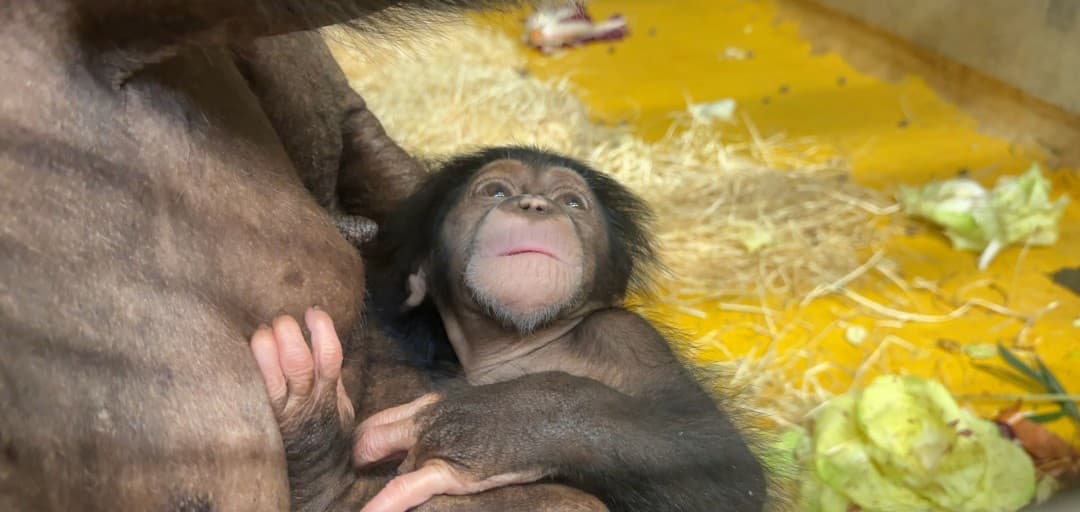
ZOO Ljubljana celebrates a new member of the chimpanzee family
27-year-old chimpanzee Neža, daughter of the charismatic Mojca, has become a mother for the third time. With 38-year-old male Boris, who came to Ljubljana from Zagreb Zoo, she had her third baby on 2 January this year — a male named Togo. The youngster joins his 10-year-old sister Leona and 5-year-old brother Tai.
"The birth was expected, but not to the day. In the morning during feeding we noticed Neža was behaving a little differently, so we assumed the birth was near. As Neža is an experienced mother, the birth went quickly, without complications and entirely on her own. We keepers withdrew and monitored the events via cameras throughout. The rest of the chimpanzee family also withdrew during the birth," said chimpanzee keeper Tomaž Mur, who was present at the birth.
A name with a conservation message
The keepers chose the name Togo after the West African country where western chimpanzees (Pan troglodytes verus) are locally extinct in the wild — as they are in neighbouring Benin and Burkina Faso. The population of western chimpanzees has fallen by around 80% over the past 25 years. The International Union for Conservation of Nature (IUCN) estimates that only between 18,000 and 55,000 still live in the wild of West Africa today. Western chimpanzees are threatened primarily by habitat loss driven by the expansion of oil palm, rubber, eucalyptus and sugar cane plantations. Logging, mining and oil extraction also contribute to habitat loss and lead to the fragmentation of their environment. Once extensive, connected habitat has been reduced to small forest patches separated by farmland, roads and other human activity. The chimpanzees’ access to food sources is therefore severely restricted, and so is contact with other groups of chimpanzees, which leads to a decline in genetic diversity. As agriculture expands into the chimpanzees’ living areas, they increasingly raid agricultural crops, causing local residents to view them as pests and persecute them. Close contact between humans and chimpanzees also leads to an increasing crossover of human diseases to chimpanzees, which are not adapted or resistant to them. The most dangerous is the viral disease Ebola, which in some places has caused local extinctions of the species. Flu, tuberculosis, leprosy, polio and many other diseases are also very dangerous for wild populations.
A veterinary view
"Every new birth brings joy to the zoo, but also new challenges for us vets. Neža shows us the baby so we can assess him visually — we check the number of fingers and any congenital abnormalities — but she does not allow photography. Through observation and cooperation with keepers we monitor whether the baby is suckling, gaining weight and developing normally," said head vet at ZOO Ljubljana, Dr Pavel Kvapil.
Vet Peter Omejc also highlights the importance of safety: "Chimpanzees are very sensitive to human diseases. What is a mild cold for us can be fatal for them. That is why all of us who are in close contact with them rigorously follow biosecurity measures. We ask visitors to be respectful to the chimpanzees — not to tap on the glass, to keep their distance if they are ill, and so help prevent the spread of disease."
How chimpanzee babies develop
Female chimpanzees have offspring every four to seven years, with pregnancy lasting around seven and a half months. They usually give birth to a single baby, who at birth is completely dependent on the mother. Babies weigh around 1.5 to 2 kg, are born without teeth, with sparse hair and very poor vision. As the mother moves a lot, the
baby clings tightly to the hair on her belly in the first weeks, and the mother additionally supports him for the first few days. During the first months the young feed exclusively on mother's milk. Around 3 to 6 months they gradually start tasting solid food, exploring their surroundings and bonding more closely with other family members. Nursing can last four to five years, and during this time the young learn social rules, communication and tool use. They stay with their mother for between 7 and 11 years. Females move into other groups upon maturity, while males usually stay in their natal group for life.
Why we do not show the baby straight away
"We do not show the baby to the public straight away, because we want the postnatal period to pass calmly and safely, the bond between mother and baby to become firmly established, and the entire chimpanzee family to accept him. When we see everything is in good order, we gradually introduce the baby to visitors too," explains ZOO Ljubljana vet Dr Marjan Kastelic.
We ask visitors to behave respectfully at the chimpanzee enclosure: please do not tap on the glass, use flash when taking photographs, shout or feed the animals. If you are ill, please keep a step or two away. By following zoo etiquette together, we ensure the visit is safe and enjoyable for animals and people alike.
End of release
Photo credit: "ZOO Ljubljana Archive"
Press contacts: Vet: Peter Omejc, veterinarska.ambulanta@zoo.si, 041 331 295
Curator: Špela Štrus, spela.strus@zoo.si, 051 344 091