Black Stork Chicks
11. May 2022
11. May 2022
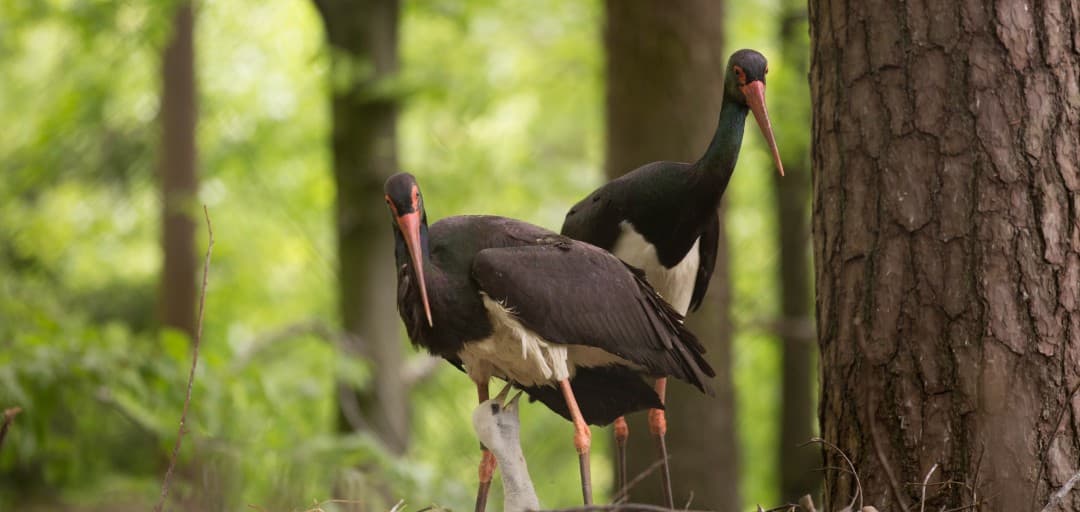
Black storks (Ciconia nigra) are classified as wading birds. They live in lowland marshy forests and meadows, far from human settlements. They nest successfully where there are enough large trees with strong branches and shallow wetlands where they can feed undisturbed by people. In Slovenia they nest in the Krakovski forest, Ljubljana Marshes, Lake Cerknica, along Murska Šuma and in the Soteska valley near Kamnik. A pair of storks builds a very large nest from branches, in which the female lays up to 5 white eggs and incubates them for up to 36 days. The parents bring food and water to the chicks in their beaks until the chicks first fly at about 71 days old.
Black storks feed on fish, newts and other amphibians, which they catch with their long, strong beaks. They look for food in shallow waters that can be up to 15 km from the nest. In winter their prey becomes torpid due to low temperatures, so they migrate to southern lands before winter. Black storks are excellent gliders. They rely on warm air currents that form over land, so they cross the Mediterranean via the straits. Storks from eastern Europe migrate via Gibraltar, and storks from western Europe via the Bosphorus and Sicily. They fly with their necks extended, which distinguishes them in flight from herons, which have their necks bent.
Black storks have excellent vision. Their eyes point forwards, surrounded by a distinctive red patch. From beak to tail they measure up to 100 cm, with a wingspan of up to 155 cm. They weigh up to 3 kg. Their long legs, neck and beak mean they do not wet their feathers when wading through water to find food. On their chests they have special feathers known as powder down. The feathers grow continuously, and the tips crumble into a powder which the birds spread over their plumage with their beaks to keep water from soaking in.
When they sleep and rest, they stand on one leg, tucking the other under a wing. They alternate legs while resting. They live up to 18 years.
The black stork is classified as least concern on the IUCN Red List, although it is locally endangered in many places. In Slovenia it is classified as vulnerable, but fortunately the number of pairs has been increasing in recent years. The population is estimated at 40 to 60 pairs.
Black storks are threatened by humans who occupy and alter their natural habitat. Forests are cleared for agriculture and industry and dams are built, so black storks have less and less space to nest and feed. Due to agricultural activity and pollution, their wintering grounds in Africa are also threatened.
The species is kept at many zoos that are members of the European Association of Zoos and Aquaria (EAZA), and a studbook is maintained to prevent inbreeding. We at ZOO Ljubljana have also been successfully breeding black storks for many years.
In the aviary, a pair of black storks lives with a flock of night herons. The male hatched at Ljubljana Zoo in 2015, and the female, which hatched in 2016, came to us from Zagreb Zoo. Specialists set up the framework of a nest on a tree for them, which the birds further completed with branches. This year the female laid eggs in the nest and successfully incubated them, as keepers spotted chicks in it at the end of April. The parents are very attentive; the female warms the brood, while the male brings them food.
The black storks at ZOO Ljubljana are used to visitors, but by nature they are more timid than white storks, especially during nesting. We therefore ask visitors to watch them only from the viewing paths and to respect that the pair of storks needs peace to raise their brood successfully.
Did you know: The most famous black stork in Slovenia was Franček. Franček was the first stork in Slovenia to be tracked by specialists from DOPPS (BirdLife Slovenia) using GPS telemetry in 2014 as part of black stork ecology research. In Slovenske gorice, they fitted him with a GPS transmitter, which did not hinder his daily activities at all. They could therefore follow him and learned that he nested successfully and raised four chicks, for which he looked for prey along the River Mura. After nesting he flew first to Hungary, then across the Adriatic to Italy, from there to Sicily and across the Mediterranean to Tunisia. Black storks mostly winter in sub-Saharan Africa.