First Red Panda Cub at ZOO Ljubljana
13. September 2022
13. September 2022
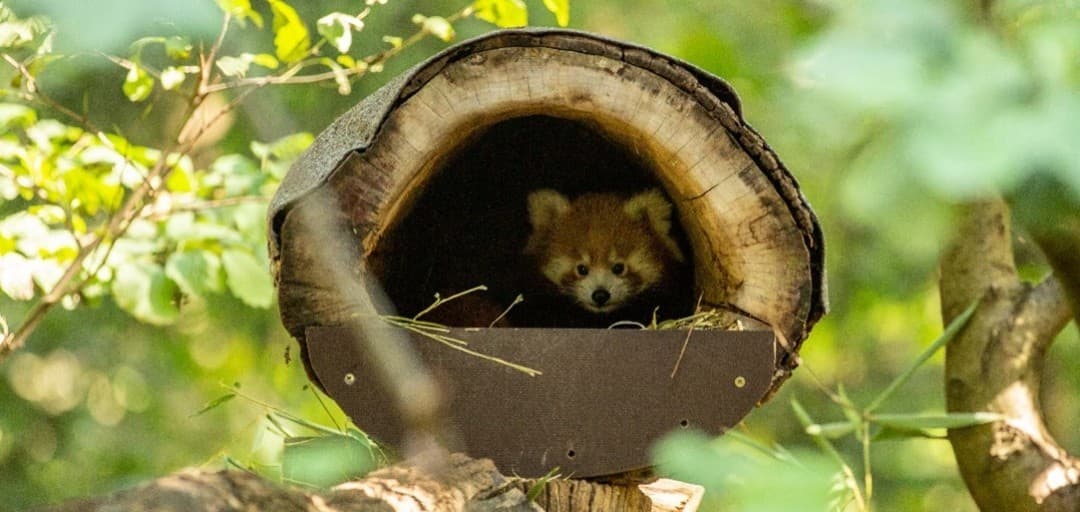
The June birth of the cub was a lovely surprise for staff, but also a challenge. Hot summers with record temperatures are not the best start for young, as they can be fatal even for adults. Red pandas are also extremely sensitive to a whole range of factors. That is why we provided additional cooling by misting at ZOO Ljubljana. The privacy of the pair, facing parenthood for the first time, was protected by an additional fence for two months.
Visitors missed little during the closure, as the cub has now started peeking out of the nest for the first time. The species’ sensitivity and the pair’s inexperience are also why the vet has not yet visited, so the cub’s sex is also not yet known. Given the characteristic love red pandas have for bamboo, we have named the cub Bambu — a name that suits either sex.
You can watch a video of the cub at the end of the article.
How does a red panda grow up?
After four and a half months in the dens that females prepare in the last days of pregnancy, they usually give birth to one or two cubs. They need several different dens at different heights, as they move the cubs several times. The cubs are helpless, blind and covered in grey fur. They sleep most of the day. They open their eyes after 18 days and only get a coat like the parents — which helps camouflage them in the natural habitat — at three months, when they start leaving the nest.
The home of red pandas is the high-altitude deciduous forests of the eastern Himalayas with bamboo undergrowth. Their dark-coloured belly protects them from predators looking up, while their red colour helps them blend in among tree trunks covered in reddish mosses and white lichens. Pandas rest high in the trees for as much as 17 hours a day; the rest of the time they feed in the bamboo undergrowth, as they need up to 2,000 bamboo leaves per day, which make up as much as 95% of their diet or 30% of their body mass.
The name panda was first given to the red panda, discovered 50 years before the today better-known and much larger giant panda. The two pandas are not closely related and also differ quite a bit from the bear family. They mostly share a common ancestor, a name, bamboo and a sixth ''thumb'' that allows them to grip bamboo stems — and allows red pandas to also climb head downwards. No wonder red pandas are also called the cat-bear, bear-cat, firefox, or even a bit of a raccoon relative. Originally, the name ‘panda’ means ‘bamboo eater’. Recently, scientists discovered that in red pandas we have two species, not just one.
ZOO Ljubljana’s research contribution to red panda conservation
ZOO Ljubljana is the initiator and coordinator of the Red Panda Amdoparovirus project, in which — in cooperation with the Veterinary Faculty in Ljubljana and UC Davis in California — we are investigating the presence and impact of the virus on the red panda population at zoos across Europe. It was first described only in 2018, the same year the red panda Shana suddenly died at ZOO Ljubljana. Based on the first diagnosed case in Europe, ZOO Ljubljana decided to research this virus and launched a study at all European zoos. Through international cooperation and research, we aim to make a significant contribution to a healthy population of these animals in the future, both in zoos and in the wild. The project runs within the European Endangered Species Programme (EEP) for red pandas, under the European Association of Zoos and Aquaria (EAZA).
ZOO Ljubljana’s conservation contribution to red panda preservation
Although red pandas have only been known for just under 200 years, they are now severely endangered. Only around 10,000 remain in the wild, and it has recently been shown that even these belong to two species rather than one.
As members of the European Association of Zoos and Aquaria (EAZA), we participate in projects to conserve red pandas in the wild through the Red Panda Network, which we at ZOO Ljubljana have also financially supported since 2016. This year we contributed funds for a red panda guardian in the nature park where they live, and for the reforestation of one hectare of forest with bamboo. We invite all panda enthusiasts to join ZOO Ljubljana’s activities to save these wonderful animals and contribute with a donation to the panda money box at the entrance, a purchase in the online shop, or by contributing €1 for a bamboo shrub. All funds raised will go to the Red Panda Network for red panda conservation in the wild.